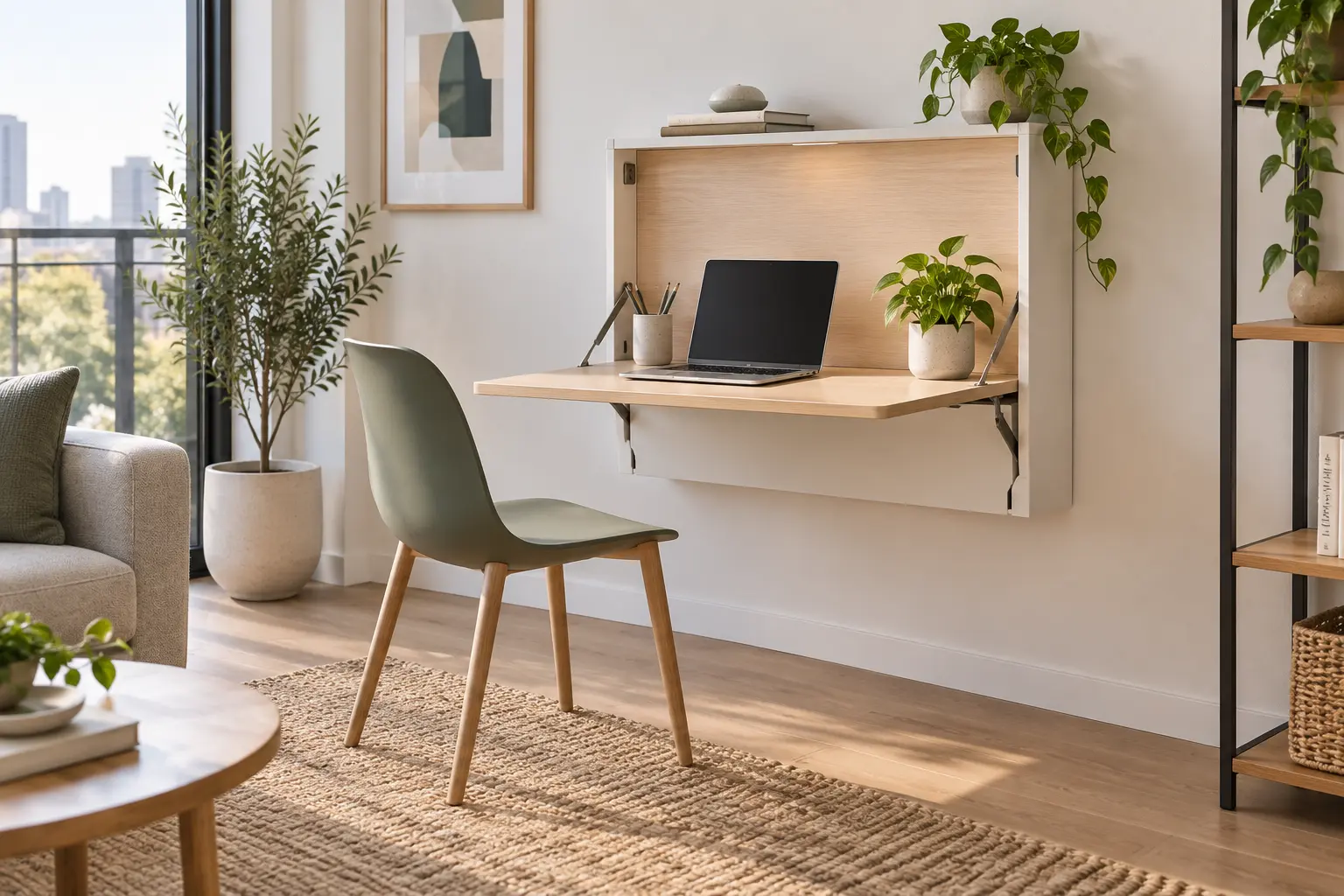
What a wall mountable desk must solve
A wall mountable desk replaces a floor footprint with a fixed relationship to the wall. That can help in a bedroom, hallway, studio, or small home office, but it moves the main decisions into installation and ergonomics. The useful question is not whether the desk looks compact in a product image. It is whether the surface sits at a usable height, supports the equipment you actually use, and leaves enough room to sit, stand, fold, and move around it.
Start by defining the job. A shallow surface may work for a laptop and notebook; a deeper top may be needed for a monitor, keyboard, lamp, or paperwork. A drop-leaf model saves space when closed, while a fixed shelf can remain ready for daily use. The correct format depends on how often the desk changes state and whether you can leave a chair in place.
Measure the wall and the working height
Measure the available wall width, baseboard height, outlet position, nearby doors, and the distance to furniture on both sides. Mark the proposed top with painter’s tape and place a chair beneath it. Check elbow angle, screen height, knee room, and whether the chair can pull back without striking a bed or cabinet. A desk that fits the wall can still create an uncomfortable workstation.
Use the manufacturer’s finished height and depth rather than a generic desk label. Folding legs, brackets, or a rear lip can reduce usable depth. If multiple people will use the desk, test the tallest and shortest regular user. A wall-mounted surface has less adjustment than a freestanding desk, so mounting position deserves the same care as chair selection.
Check the wall, hardware, and load guidance
The wall structure determines what installation is possible. Drywall, masonry, and wood framing need different anchors and fastening methods. Read the manufacturer’s mounting instructions and confirm whether hardware is supplied or merely shown in the photographs. Do not treat a decorative bracket as proof that the included hardware suits your wall. When the mounting surface is uncertain, obtain the appropriate local installation advice before drilling.
Load guidance should be read with the mounting method and the desk’s position in mind. A stated capacity may assume a particular fastener pattern and a fully supported bracket. Distribute equipment across the surface instead of concentrating weight at the front edge. A monitor arm, printer, or stack of books can create leverage that a simple weight total does not describe.
Compare fixed, folding, and cabinet-style designs
A fixed wall desk is easier to keep ready and often feels more stable, but it occupies the same wall projection all day. A folding desk reduces the projection when closed, though its hinges, stays, and latch become daily-use components. Cabinet-style units can conceal supplies and cables while adding depth, door swing, and visual weight. Choose the mechanism around the routine, not the novelty of hidden storage.
Test the open and closed footprints with tape. Check whether the chair must be moved before the top can fold and whether the folded panel blocks an outlet, switch, or walkway. Inspect how the support legs or brackets lock. A mechanism that needs two hands may be acceptable in a guest room and irritating in a workstation used several times each day.
Plan monitor, cable, and lighting access
A desk surface is only useful when the equipment can connect without turning the wall into a tangle. Locate outlets before choosing the desk and map the path for power, display, and charging cables. A rear cable opening can help, but it does not replace measuring plug depth and adapter size. Check whether the top allows a clamp-on monitor arm or whether the edge is too thick or delicate.
Lighting needs its own footprint. A lamp may reduce writing space, while a wall light or clip light needs a safe mounting point and a cable route. Keep heat-generating equipment away from fabrics and enclosed compartments. If the desk folds, verify that cables can move without being pinched. Cable management should support the desk’s movement rather than prevent it.
Finish, cleaning, and daily comfort
Laminate, veneer, solid wood, and painted engineered panels have different responses to moisture, heat, and scratches. Read the care instructions and consider the objects placed on the top every day. A glossy dark finish may show fingerprints, while a textured or lighter finish can be easier to live with. Edge treatment matters because wrists contact the front edge for long periods.
A wall desk needs a clear reset routine. Decide where the chair goes when the desk is closed, where stationery lives, and how the surface will be cleared before folding. Confirm whether the support hardware can be inspected after installation and whether the finish can be touched up. A desk that is technically compact but difficult to reset may not save practical space.
Final wall desk checklist
Before ordering, verify wall type, mounting instructions, finished width, depth, height, open and closed projection, load guidance, hardware, cable access, surface material, chair clearance, assembly, delivery package size, and returns. Keep the packaging until the desk is installed and checked. Photograph the wall and mark stud or anchor locations before beginning work.
The best wall mountable desk preserves floor space while giving the user a stable, comfortable work surface. Measure the person, the equipment, and the wall together. Select the mechanism only after deciding how often the desk changes state. Installation quality and everyday clearance matter as much as the desktop finish.


