
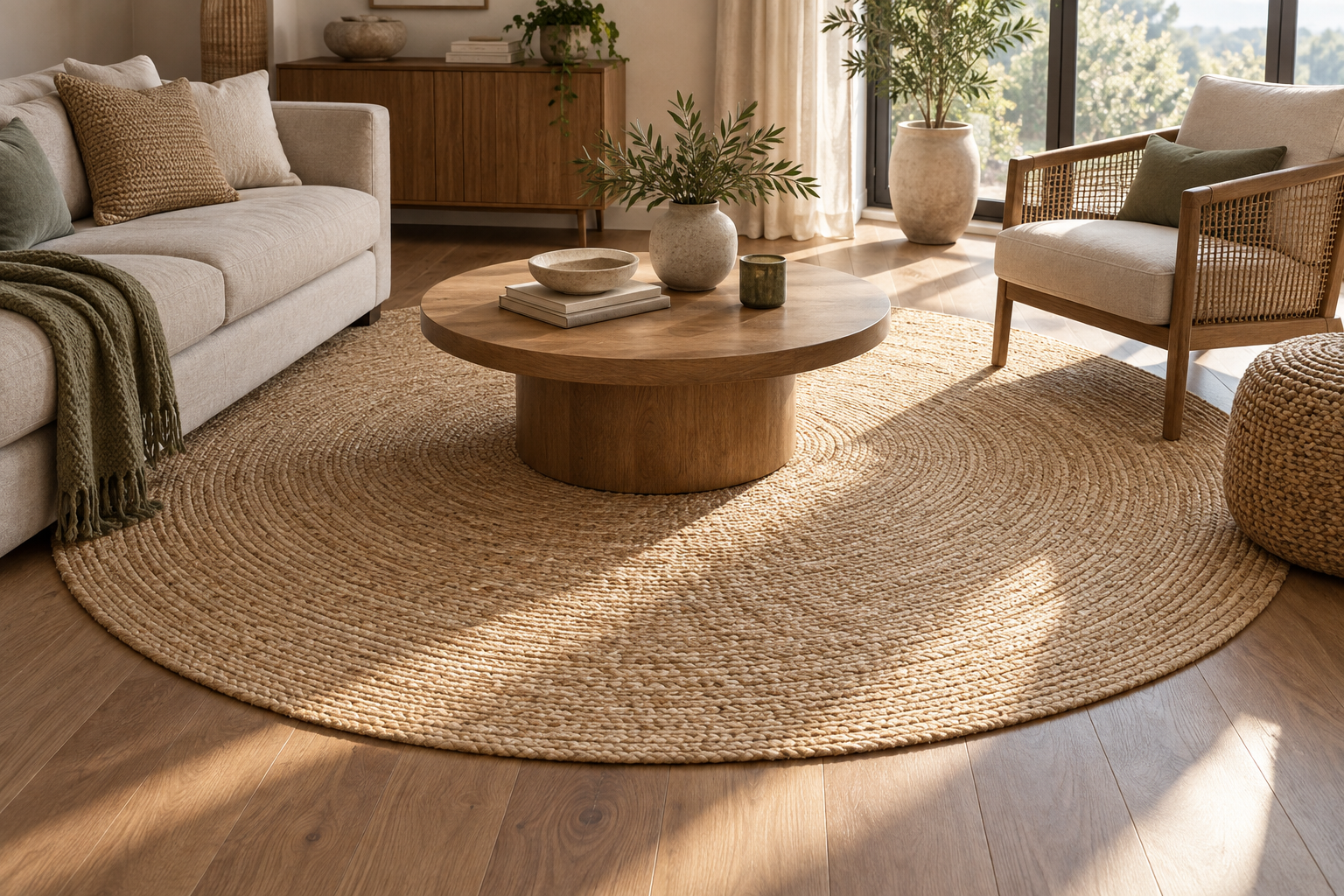
Use the circle to solve a specific room problem
Round rugs are useful because they interrupt a room's straight edges. A circle can define a reading corner, soften a square coffee table, make a small entry feel less rigid, or give a compact dining area a clear center. It also uses floor area differently from a rectangle, so the shape should answer a layout problem. If the room needs a long path or a continuous sofa-to-console connection, a rectangular rug may be more efficient.
Start by identifying the anchor: a coffee table, dining table, bed, chair, or small grouping. The rug should support that anchor rather than float beneath one random object. Note where people walk, where doors swing, and where furniture legs need stable support. A circle that looks decorative in isolation can create awkward gaps around a sofa or leave the front legs outside the composition.
Choose diameter with tape and furniture overlap
Measure the diameter you are considering, then mark the full circle on the floor with painter's tape or a string compass. Place the actual furniture inside the outline. In a seating area, decide whether the rug will sit under the coffee table only, under the front legs of the chairs and sofa, or under the entire grouping. Each option creates a different visual weight. The correct diameter is the one that makes the furniture look connected without narrowing the circulation path.
A bedroom uses a different test. A round rug can sit under the lower half of a bed, beside the bed as a small landing surface, or under a chair and side table. Keep the circle clear of drawers and doors. In a dining area, account for chairs pulled out from the table; the rug should not end directly beneath the back legs where the chair catches on the edge.
Let pile height follow doors and movement
Pile changes the feel and the clearance. A high pile adds softness and visual depth, though it can catch under doors, make chair movement harder, and collect more debris. A low pile or flat weave is easier to move across and often suits dining or entry zones. A braided or woven texture can emphasize the circular shape and may show small shifts in tension or edge curling. Look for the construction details that explain how the rug will behave after repeated walking.
The rug pad deserves its own measurement. It should support the rug without extending visibly beyond its edge, and it should suit the floor surface. A pad can reduce slipping and help the rug lie flatter, but it can also change the finished height beneath a door or chair. Check the care guidance for both rug and pad. Do not assume that a thick pad is always the most practical option.
Compare fiber, color, and cleaning reality
Fiber selection should follow the room's traffic and maintenance. Wool can provide a resilient, textured surface and may shed when new. Cotton and flat-woven fibers can feel lighter and easier to move, though they may shift without a good pad. Synthetic fibers can offer practical stain resistance depending on the construction, while natural fibers such as jute bring texture and may respond differently to moisture. Read the care instructions before selecting the look.
Color and pattern affect the perceived size of the circle. A high-contrast border makes the edge clear and can emphasize the shape. A low-contrast neutral rug blends into the floor and may make a small room feel calmer. Pattern can disguise minor debris and create a focal point, but a large motif may be interrupted by the table or furniture legs. View the rug in the light it will actually receive, especially near a window.
Place the circle with intention
A round rug can make a room feel balanced when it repeats a nearby curve: a circular table, an arched doorway, a rounded chair, or a pendant shade. Repetition is optional, though the rug should have enough breathing room to read as a deliberate shape. Avoid forcing a circle into a narrow rectangle simply because the style is popular. The edges should clarify the zone rather than create a series of leftover slivers.
Layering can work when the lower rug supplies enough area and the upper round rug marks a smaller activity. Keep the materials and pile heights compatible, and make sure the edges do not create a trip point. In a busy home, choose a placement that makes vacuuming and spot cleaning straightforward. A rug that requires moving half the room for every clean will eventually be neglected.
The round rug decision
Before ordering, measure the diameter, furniture overlap, door clearance, pad size, pile height, fiber, backing, care method, and return terms. Mark the circle on the floor and live with it for a day if the room is tight. Confirm whether the edge arrives flat, whether the rug can be rolled, and how long any initial odor or shedding may last according to the product guidance.
The best round rugs give a room a clear center without sacrificing movement. Choose the diameter to connect the furniture, the pile to suit the traffic, and the fiber to suit your maintenance habits. Once the practical geometry works, color and texture can provide the softness or contrast that made the circle appealing in the first place.
